What Does a Robot Workcell Include? A Buyer's FAQ Guide (vs. a Standalone Robot)

One-line summary: A standalone robot is one component. A working welding cell also needs guarding, a positioner, end-of-arm tooling, controls, safety systems and commissioning — this FAQ guide explains each layer, using the YGT dual-axis welding positioner and BRTIRWD1506A welding cell as a worked example.
Author / Company Identity: YGT Engineering Team — Guangdong Yigaite Intelligent Technology Co., Ltd. (YGT Robot), a system integration and application provider for industrial robot automation. We do not manufacture robot arms; we integrate them into production cells.
The Customer Problem: Why the Quote Doesn't Match the Budget
Most buyers start with a robot model and a quoted price for the arm. Then the project stalls. The arm arrives, but there is no fixture to hold the part, no positioner to rotate the weldment, no fence, no interlock, no welding package, and no one to integrate the torch with the power source. The gap between "robot price" and "cell price" is often the single biggest surprise in a first automation project.
The problem is not the robot. It is that the robot is one part of a system. A robot workcell is a coordinated set of mechanical, electrical, control and safety subsystems that together perform a process. Understanding that scope early lets you plan floor space, utilities, staffing and budget realistically — before you sign a purchase order.
Why Automation: What a Workcell Actually Buys You
Automation is not a robot purchase. It is a production capability purchase. A well-integrated cell delivers:
- Consistent quality: The same weld, the same angle, the same travel speed, shift after shift. Repeatability is a system property — it depends on the fixture and positioner as much as the arm.
- Repeatable production: Predictable cycle times and output that does not depend on operator fatigue or skill variation.
- Long-term cost reduction: Labor is redeployed to higher-value tasks; rework and scrap from inconsistent manual welds go down.
- Production flexibility: A cell can be reprogrammed for new part variants within the robot's payload and reach envelope, extending the asset's useful life.
None of these outcomes come from the arm alone. They come from the integration.
Solution Logic: What a Complete Workcell Contains
A robot workcell is best understood as layers. Each layer has a function, and each must be specified, sourced, installed and commissioned.
Layer 1 — The Robot Arm
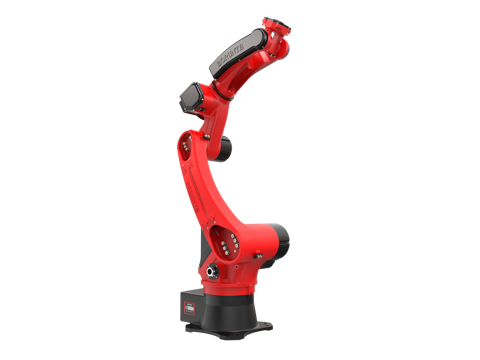
The arm provides motion. For welding, the key arm parameters are payload, working range, repeatability and controller compatibility. In the worked example below, the BRTIRWD1506A is a six-axis robot with a 6 kg payload, 1,647 mm arm reach and ±0.05 mm repeatability — numbers that matter because they determine what torch, cable and fixture weight the arm can carry, and how much of the part it can reach without repositioning.
Layer 2 — The Positioner
A welding positioner rotates or tilts the workpiece so the robot can reach the weld joint at the correct angle. A dual-axis welding positioner adds a second axis of motion, allowing the part to be indexed between weld stations or presented at compound angles. This is often the difference between a cell that welds one joint orientation and a cell that can handle a real weldment with multiple sides.
The positioner is not an accessory. It is a motion axis that must be integrated with the robot controller, synchronized in the program, and guarded like any other moving equipment.
Layer 3 — End-of-Arm Tooling (EOAT)
For welding, the EOAT is the torch, torch holder, collision sensor, water-cooling lines and cable management. For other processes, it might be a gripper, vacuum cup, dispenser or deburring spindle. EOAT selection depends on the process, the part and the robot's payload margin. A 6 kg payload arm must account for torch weight, cable drag and fixture loads.
Layer 4 — Process Equipment
The welding power source, wire feeder, shielding gas supply and fume extraction are process equipment. They are not part of the robot, but they must communicate with the robot controller — typically through digital I/O or a fieldbus interface. Compatibility here is a common integration risk and should be confirmed early.
Layer 5 — Controls and Programming
The robot controller, the positioner controller (if separate), the PLC and the safety controller must work as one system. Programming includes the robot path, the positioner motion, the weld schedule and the interlock logic. This is where most of the engineering hours sit — and where a low-cost "robot only" quote often hides its real cost.
Layer 6 — Safety Systems
Guarding, light curtains, safety interlocks, emergency stops and risk assessment are mandatory. The specific requirements depend on the market and the applicable machinery safety standards. For CE-marked installations, the cell must meet the relevant machinery and low-voltage directives; the robot model itself may carry a CE conformity verification, but the assembled cell requires its own risk assessment and validation.
Layer 7 — Installation and Commissioning
Foundation or floor anchoring, utilities (power, air, water, gas), cable routing, trial runs, operator training and documentation. Commissioning is not a formality — it is where the cell is proven against the part and the cycle time target.
Standalone Robot vs. Complete Workcell: A Comparison Table
| Scope item | Standalone robot | Complete robot workcell |
|---|---|---|
| Robot arm | Included | Included |
| Robot controller | Usually included | Included |
| Positioner / fixture | Not included | Included — dual-axis positioner and part-specific fixture |
| End-of-arm tooling | Not included | Included — torch, holder, collision sensor, cable management |
| Process equipment (power source, wire feeder, gas) | Not included | Included and integrated with controller |
| Safety guarding and interlocks | Not included | Included — guarding, light curtains, e-stops, risk assessment |
| PLC / cell control | Not included | Included — interlock logic and cell sequencing |
| Programming and path teaching | Not included | Included — robot path, positioner motion, weld schedule |
| Utilities and installation | Not included | Included — power, air, gas, anchoring, cable routing |
| Commissioning and operator training | Not included | Included |
| Documentation | Robot manual only | Cell documentation, safety file, maintenance schedule |
| Who is responsible for the process result | Buyer | Integrator, within agreed scope |
This table is the single most useful planning tool for a first-time buyer. If your quote covers only the left column, you are buying a component, not a production capability.
Worked Example: The YGT Dual-Axis Welding Positioner and BRTIRWD1506A Welding Cell
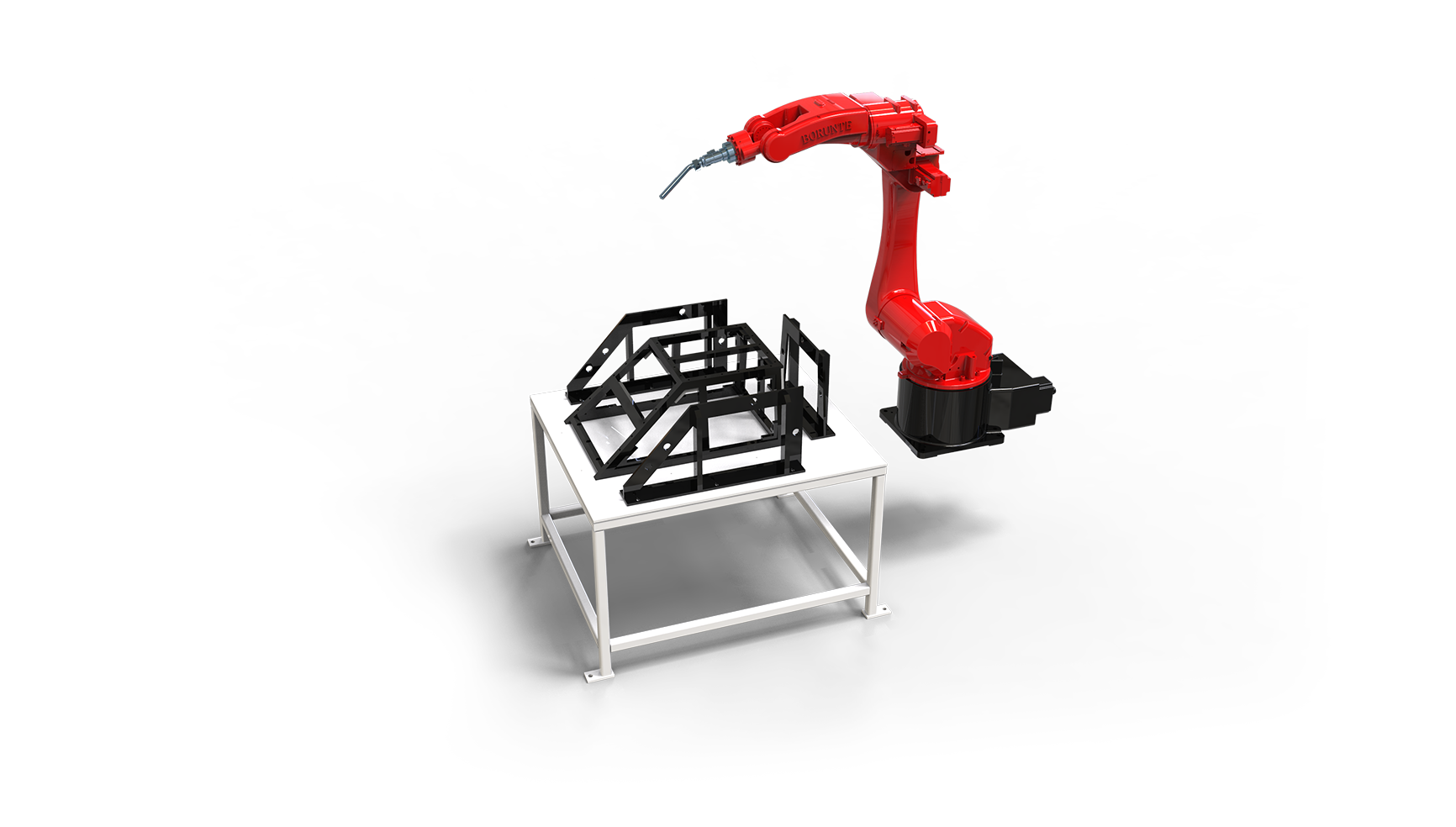
To make the scope concrete, consider a welding cell built around the BRTIRWD1506A six-axis robot and a dual-axis welding positioner, as used in YGT's industrial cart frame welding project.
The arm: BRTIRWD1506A — six-axis, 6 kg payload, 1,647 mm reach, ±0.05 mm repeatability, approximately 166 kg mass, 4.64 kVA power capacity. It carries a CE conformity verification (DPWD/03/0646/2025, covering 2006/42/EC machinery and 2014/35/EU low voltage, issued by ICG). It is not an explosion-proof model; for explosive atmospheres, a different model would be required.
The positioner: A dual-axis welding positioner presents the cart frame at the correct weld orientation and indexes it between weld sides. This is what allows a single robot to reach multiple joint orientations on a large weldment without re-fixturing the part by hand.
The rest of the cell: Torch and EOAT, welding power source and wire feeder, fume extraction, safety guarding and interlocks, cell PLC, programming, commissioning and operator training.
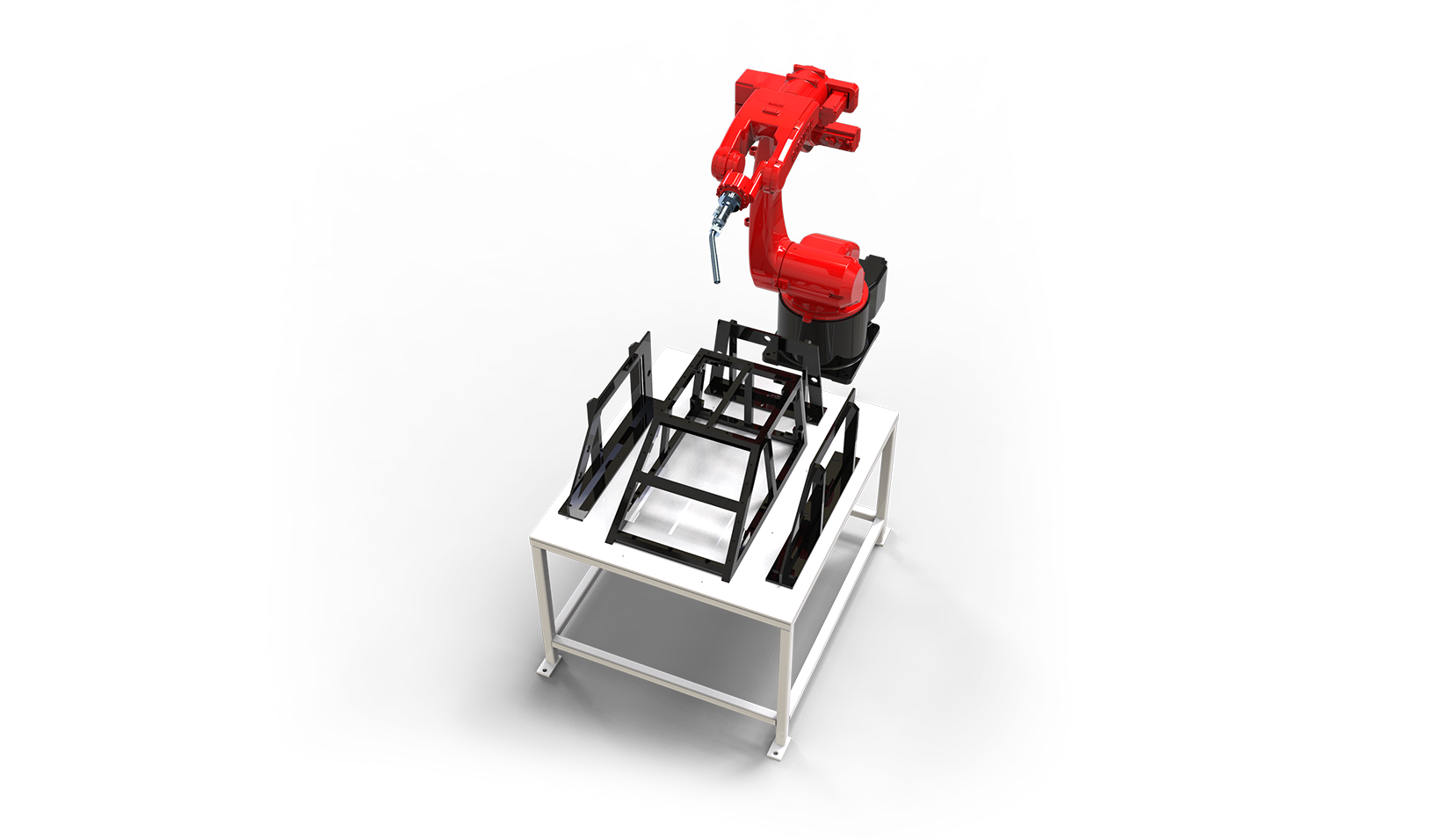
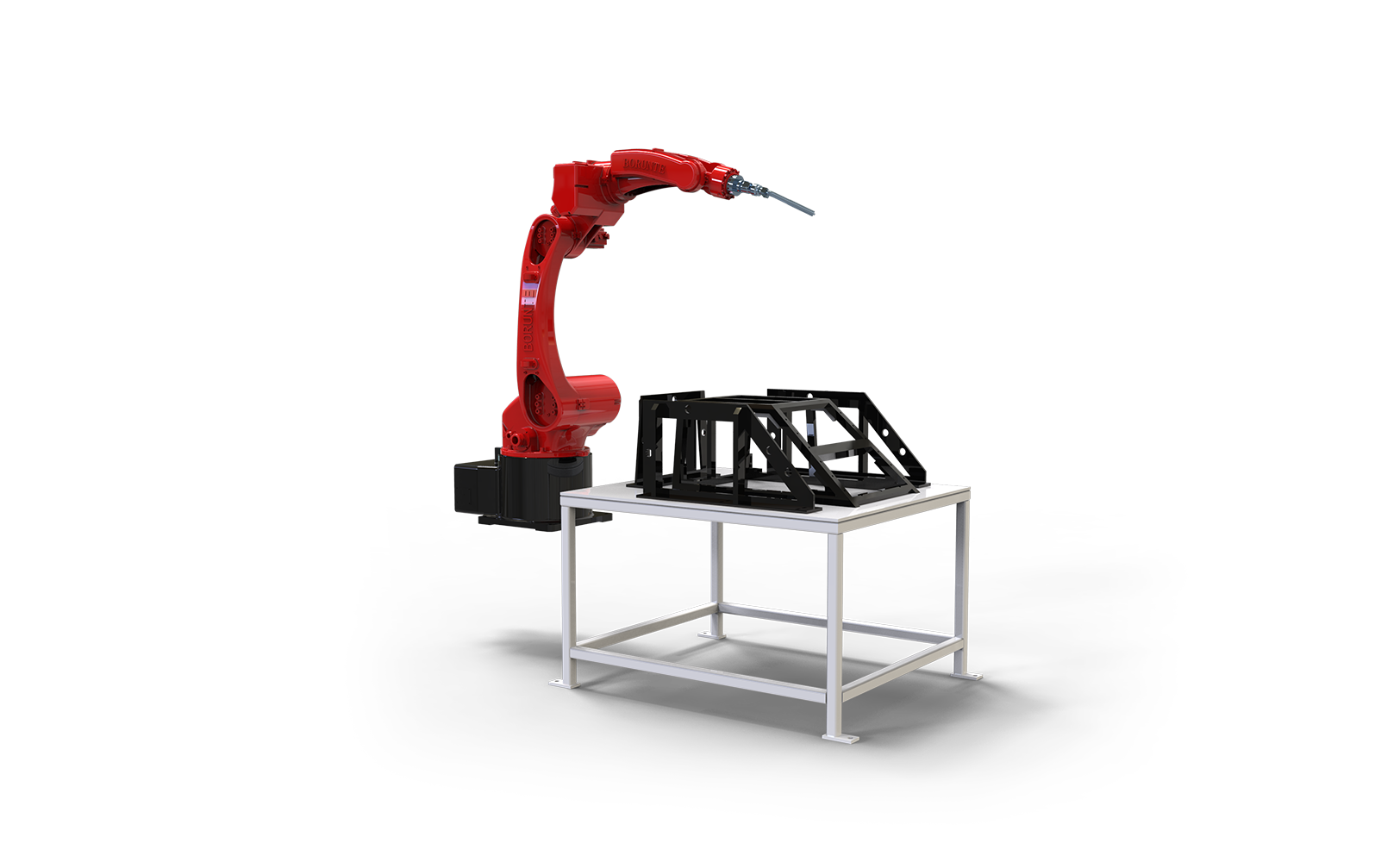
The point of the example is not the specific cart frame. It is that the arm is one line in the bill of materials. The positioner, tooling, process equipment, controls, safety and commissioning are the rest — and they are where the cell's productivity is actually determined.
Key Selection Factors for a Robot Workcell
When evaluating a workcell, these are the factors that drive both capability and cost:
- Part envelope and weight — determines robot reach and payload, and positioner capacity. A 6 kg payload arm with 1,647 mm reach suits medium-sized weldments; larger parts need a bigger arm or a different positioner strategy.
- Weld joint access and orientation — determines whether a single-axis or dual-axis positioner is needed.
- Repeatability requirement — ±0.05 mm is typical for arc welding; the fixture and positioner must be built to match, or the arm's precision is wasted.
- Process method — MIG/MAG, TIG or other; drives power source, torch and gas selection.
- Controller and fieldbus compatibility — the robot controller must communicate with the welding power source and cell PLC. Confirm the protocol before ordering.
- Safety and compliance requirements — CE, local machinery safety rules, risk assessment obligations.
- Floor space and utilities — guarding footprint, power capacity (the BRTIRWD1506A draws 4.64 kVA), air, gas and fume extraction routing.
- Commissioning and after-sales support — who programs the cell, who trains operators, who responds when a weld goes out of specification.
YGT Experience: Integration Is the Product
YGT Robot is a system integration and application provider. We do not manufacture robot arms — the BRTIRWD1506A is a BORUNTE model, and its parameters are quoted from BORUNTE selection documentation. What we bring is the integration layer: selecting the right platform for the part and process, designing the fixture and positioner arrangement, integrating the welding package and controls, building the safety system, commissioning the cell and supporting it in production.
Our confirmed application capabilities include welding, handling, loading/unloading, palletizing and spraying. For processes outside this confirmed scope — such as deburring, polishing, gluing, vision sorting, laser cutting or assembly — we do not claim capability without engineering review; those are confirmed case by case with our engineers.
This distinction matters to buyers. A robot manufacturer sells an arm. An integrator sells a working cell and takes responsibility for how the layers fit together. When you evaluate suppliers, ask which role they play — and make sure the scope of responsibility is written into the agreement.
FAQ
Q: Can I buy just the robot and integrate the cell myself? A: Yes, technically. But you take on fixture design, positioner integration, safety validation, programming and commissioning. If you do not have in-house automation engineering, the total cost and timeline usually exceed a turnkey cell.
Q: Is a dual-axis positioner always necessary for welding? A: No. It depends on the weldment. A single-axis positioner may be sufficient for parts with one dominant weld orientation. Dual-axis becomes valuable when the part has multiple sides or compound angles that would otherwise require manual re-fixturing.
Q: How do I know if a 6 kg payload robot is enough? A: Add the torch, holder, collision sensor, cable drag and any fixture load, then compare to the payload rating with a margin. Also check reach: the BRTIRWD1506A has 1,647 mm reach, which must cover the part at the required weld angle, not just at full extension.
Q: Does the robot's CE certification cover the whole cell? A: No. The BRTIRWD1506A carries a CE conformity verification for the robot model. The assembled cell requires its own risk assessment and conformity validation under the applicable machinery safety rules. This is a common compliance gap in first-time projects.
Q: What communication options are available between the robot and the welding power source? A: This depends on the specific power source and controller configuration. The connection is typically digital I/O or a fieldbus interface, but the exact protocol must be confirmed against your selected equipment. We confirm this during the engineering phase rather than assuming compatibility.
Q: Can the same cell weld different part variants? A: Generally yes, within the robot's reach and payload envelope and with appropriate fixture changeover. The number of variants and changeover time should be defined during cell design, not after installation.
Q: What is typically excluded from a workcell quote? A: Common exclusions include foundation work, compressed air and gas supply installation, fume extraction ducting to the roof, and sometimes operator training beyond initial sessions. Clarify exclusions in writing before comparing quotes.
Q: How long does commissioning take? A: It depends on cell complexity, part count and whether production trials are included. A single-robot welding cell with one or two part variants is typically faster to commission than a multi-station cell with several changeover variants. The schedule should be agreed as part of the project plan.
Related Products
- BRTIRWD1506A six-axis welding robot
Related Cases
- Industrial cart frame welding project with the BRTIRWD1506A and dual-axis positioner
CTA
If you are planning a welding cell, the most useful first step is a scope review: part drawings, weld joint requirements, target cycle time and available floor space. Send these to our engineering team and we will respond with a cell configuration outline — robot, positioner, tooling, controls and safety — so you can budget against the full system, not just the arm.