How to Justify and Phase a Robotic CNC Workcell for High-Mix, Low-Volume Machining

The real question is not "can we automate?" — it is "what do we buy first?"
In a high-mix, low-volume CNC shop, the automation conversation usually starts in the wrong place. Someone asks whether a robot can tend a machine, the answer is obviously yes, and then the project stalls — because the actual blocker is not feasibility. It is justification and sequencing.
Owners and manufacturing engineers are asked to defend a capital request against a backdrop of unpredictable order mix, short run lengths, and the very reasonable fear of installing a workcell that sits idle between jobs. The question that decides the project is narrower and more useful:
Which slice of our machining work should be automated first, with which robot, and how do we prove the payback before committing to the whole shop?
This guide sets out a defensible way to answer that — the ROI logic, the phased scope, and the selection factors that determine what to buy first.
Why automate CNC tending at all
Robotic machine tending is not a productivity gadget. In a mixed-volume environment it addresses four structural problems that manual tending makes worse as volume falls and variety rises:
- Repeatable output. A robot presents the same part to the chuck or fixture, in the same orientation, with the same insertion force, every cycle. In high-mix work, where operators rotate between jobs and shifts, that consistency is where scrap and rework quietly accumulate.
- Machine utilization during unattended hours. The gap between a machine's cutting time and its attended time is where capacity is lost. Tending automation is primarily a way to convert spindle hours that currently depend on an operator standing nearby into spindle hours that do not.
- Operator leverage, not operator replacement. In a shop running many short jobs, the skilled person is most valuable setting up, inspecting, and solving process problems — not loading parts. Tending automation moves labor from the machine door to the setup bench.
- Flexibility that survives changeover. The historical objection — "robots are for long runs" — is increasingly a programming and fixturing problem rather than a robot problem. Whether a workcell is genuinely flexible depends on how the gripper, part presentation, and program structure are engineered, which is an integration question, not a catalogue question.
Note what is not on this list: a specific percentage improvement. Any credible number has to come from your own cycle time, spindle hours, and labor cost — not from a vendor's brochure.
The ROI logic: build the case from spindle hours, not from headcount
The most common reason an automation business case fails review is that it is built on a headcount reduction that never quite materializes. A more defensible model builds from capacity.
Step 1 — Measure the addressable spindle hours
For each candidate machine, establish:
- Scheduled hours per week.
- Attended hours — hours where the machine can only run while an operator is present to load and unload.
- Unattended potential — hours where the machine could run if parts were presented automatically (second shift, night, weekends, operator breaks, setup of the next job).
The gap between (1) and (2) is the pool of capacity the workcell is trying to unlock. This is the single most important number in the whole business case, and it is measured, not assumed.
Step 2 — Convert hours into contribution, not savings
Unlocked spindle hours only have value if there is demand to fill them. Model the case as additional contribution margin from parts that would otherwise be outsourced, delayed, or declined — rather than as labor cost removed. In high-mix shops, the honest version of the benefit is usually "we can accept this work and hold the lead time," which is a revenue argument and survives scrutiny better than a labor argument.
Step 3 — Cost the full workcell, not the robot
A robot is a component of a system. The defensible cost basis includes:
- Robot and controller
- End-of-arm tooling (gripper or vacuum, jaws, sensors)
- Part presentation — magazines, pallets, conveyors, or drawer systems
- Machine interface — door actuation, chuck/fixture signalling, in-process gauging where used
- Safeguarding, fencing, and risk assessment
- Integration, programming, and commissioning labor
- Training and the first months of production support
A business case that costs only the robot will pass review and then fail in execution. The comparison below is a useful way to frame the two paths honestly.
Manual tending vs. robotic tending — what actually changes
| Dimension | Manual tending | Robotic tending workcell | What to verify in your own shop |
|---|---|---|---|
| Output consistency | Varies with operator, shift, and job fatigue | Repeatable presentation cycle to cycle | Part-to-part variation and fixture repeatability |
| Machine utilization | Limited to attended hours | Extends into unattended hours | Whether the process is stable enough to run unattended |
| Changeover effort | Fast for a skilled operator | Depends on gripper and program design | Number of changeovers per week; setup time per job |
| Labor deployment | Operator tied to the machine door | Operator freed for setup, inspection, and process work | Whether the freed time has somewhere useful to go |
| Part size and weight range | Human-limited but broad | Bounded by robot payload and reach | Heaviest and largest parts in the candidate family |
| Quality feedback | Operator sees and feels the part | Requires sensing or inspection strategy | How deviations are detected without an operator present |
| Best fit | Very low volume, very high variety, tight spaces | Repeatable families with meaningful unattended potential | Where your order mix actually clusters |
| Scaling path | Add people | Add machines, cells, or shifts | Whether the cell design can be replicated |
Solution logic: what a CNC tending workcell actually consists of
A workcell is an integration problem before it is a robot problem. The pieces that determine whether it works in production:
- Part family definition. Group candidate parts by geometry, weight, and fixturing similarity — not by customer. The workcell should be scoped to a family, not to a single part number.
- Part presentation. How parts arrive at the pick point is usually the hardest engineering problem in high-mix tending, and the one most often under-scoped. Magazine, pallet, or drawer systems each impose different constraints on cycle time and changeover.
- Gripping strategy. Jaw grippers, vacuum, or hybrid end-effectors are chosen against part geometry, surface finish requirements, and whether parts are raw, semi-finished, or finished. Grip reliability under chips, coolant, and orientation variation must be designed, not assumed.
- Machine interface. Door opening, chuck or vise actuation, cycle-start handshake, and in-process gauging. The interface determines whether the cell can run truly unattended or only semi-attended.
- Safety and compliance. Risk assessment, safeguarding, and the applicable machinery and low-voltage requirements for the destination market.
- Programming and job management. How a new part is introduced, and how long that takes, is the practical definition of flexibility in a high-mix shop.
A useful test of any proposed cell: ask how a new part in the same family gets added. If the answer involves significant re-engineering, the cell is not high-mix ready.
Key selection factors: choosing the robot and the first scope
Robot selection factors
| Factor | Why it matters in CNC tending |
|---|---|
| Payload | Part weight plus gripper weight, with margin for dynamic loads |
| Working range / arm reach | Must cover machine door, chuck, and part presentation without awkward extensions |
| Repeatability | Determines whether insertion into fixtures and chucks is reliable over thousands of cycles |
| Controller and machine interface | Determines how cleanly the robot talks to the CNC |
| Footprint and mounting | Constrains cell layout in existing shop floors |
| Certification for destination market | Required for CE-marked installations in Europe |
| Service and spares access | Downtime cost in a single-cell shop is high |
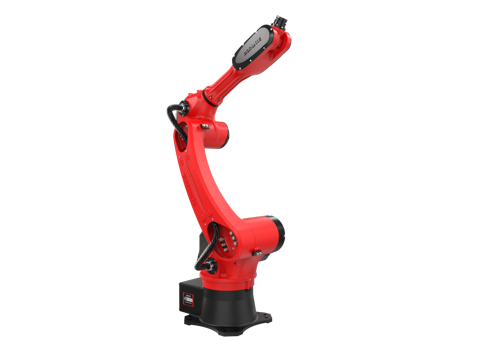
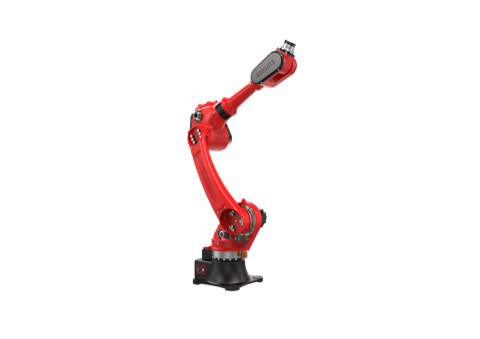
Two models in the BORUNTE range illustrate how the payload/reach trade-off plays out in practice:
- BRTIRUS1510A — 10 kg payload, 1,587 mm arm reach, ±0.05 mm repeatability, approximately 152 kg robot weight, 5.06 kVA power capacity. Suited to lighter parts and single-machine tending where reach is not the constraint.
- BRTIRUS1820A — 20 kg payload, 1,895 mm arm reach, ±0.05 mm repeatability, approximately 230 kg robot weight, 5.87 kVA power capacity. Suited to heavier parts, larger fixtures, and cell layouts where one robot serves more than one machine.
Both are six-axis robots with CE conformity verification. Neither is explosion-proof — the BORUNTE range offers a dedicated explosion-proof model separately, which matters if the shop environment requires it.
Scope selection: what to buy first
The sequencing decision matters more than the model decision. Three viable first scopes:
Option A — One robot, one machine (one-to-one). Lowest capital, fastest to justify, simplest to operate. Best when a single machine is the bottleneck and the part family is stable. It proves the concept with minimal risk.
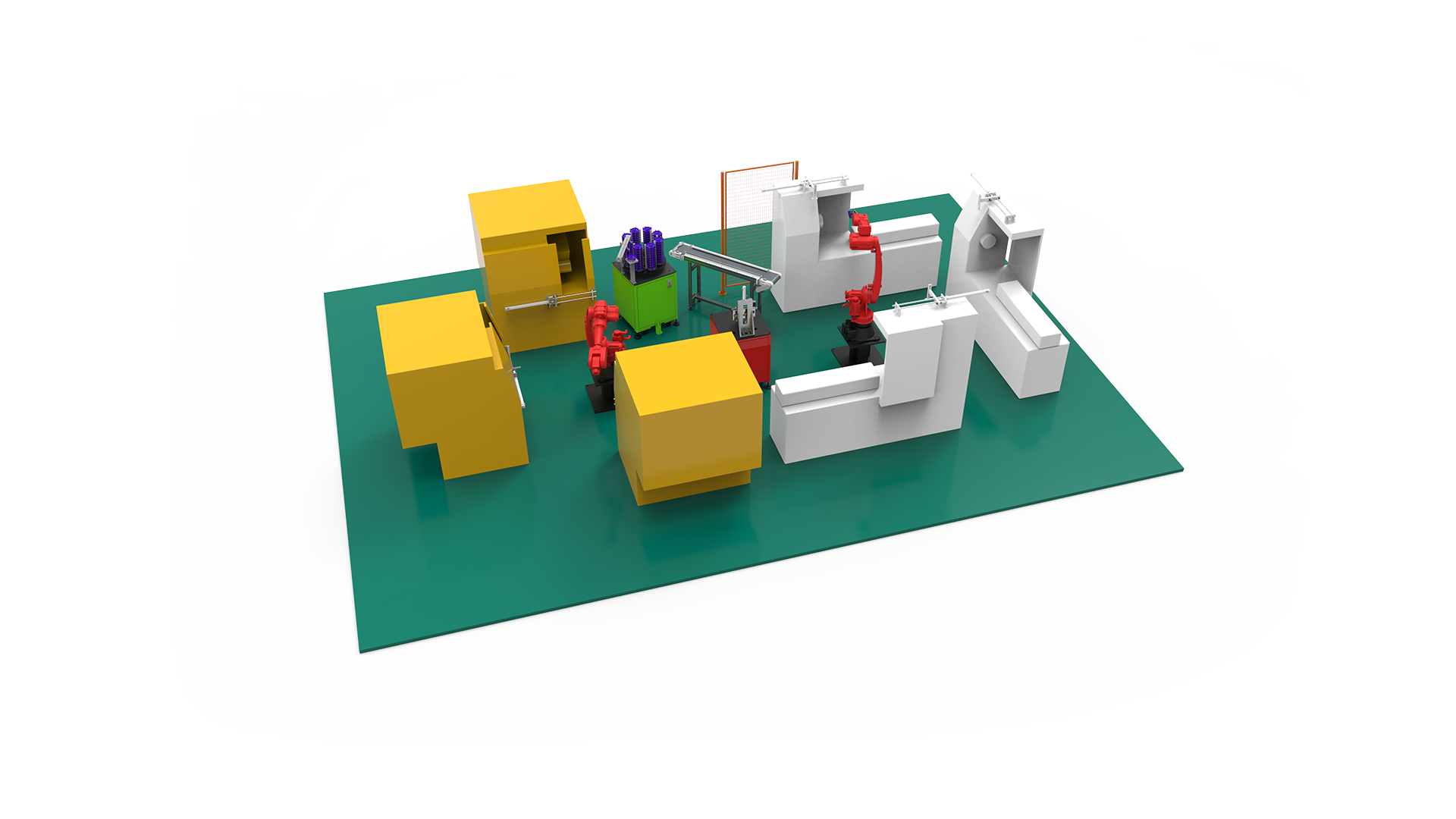
Option B — One robot, multiple machines (one-to-many). The BRTIRUS1820A layout above is an example of this pattern: a single robot serving three CNC machines. Higher capital but better robot utilization, and the economics improve sharply when the machines' cycles are long enough for one robot to tend them without waiting. Best when several machines share a part family and the cycle-time balance works.
Option C — One machine, one robot, replicated later. Buy the smallest defensible cell, run it for a defined period, then replicate the proven design. Best when the shop wants a repeatable template rather than a single showcase cell.
A practical rule: buy the scope you can operate, then expand the scope you have proven. A one-to-three cell that runs unattended is a better first purchase than a larger cell that needs an engineer on call.
YGT experience: where the integration work actually sits
YGT Robot's role in CNC tending projects is integration and application engineering — selecting the appropriate robot platform for the part family and cycle requirements, then engineering the gripper, part presentation, machine interface, safeguarding, and programming that turn a robot into a production workcell.
The recurring lesson from CNC tending work is that the robot is rarely the source of project risk. The risk sits in part presentation and changeover. Shops that scope the part family tightly, design the presentation system for the actual mix, and plan for how new parts are introduced tend to get a cell that keeps running. Shops that scope around a single part number tend to get a cell that works beautifully for one job and then sits idle.
That is also why the phased approach matters: the first cell is where you learn your own changeover economics, and that learning is what makes the second cell cheaper and faster.
A note on what this guide does not give you
It does not give you a payback period, a labor saving figure, or a price. Those depend on your spindle hours, your part mix, your labor cost, and your fixturing — and any vendor who supplies them before understanding your shop is guessing. The framework above is designed so that you can populate it with your own numbers and defend the result.
FAQ
Can a robot tend a CNC machine in a high-mix, low-volume shop, or is that only for long runs?
The constraint in high-mix work is changeover and part presentation, not the robot itself. A cell scoped to a part family — grouped by geometry, weight, and fixturing similarity — can handle variety, provided the gripper and presentation system are designed for changeover. The practical test is how long it takes to introduce a new part in that family.
What is the first thing I should measure before building an ROI case?
The gap between scheduled machine hours and attended machine hours. That gap is the addressable capacity the workcell is trying to unlock. Build the case on that number rather than on headcount reduction, which is harder to defend and less often realized in mixed-volume shops.
Should I buy a one-to-one cell or a one-to-many cell first?
Buy the scope you can operate, then expand the scope you have proven. A one-to-one cell is the lowest-risk way to validate changeover economics and unattended running. A one-to-many layout — such as a single robot serving three machines — improves robot utilization but requires the machines' cycles to balance and the part family to be shared.
How do I choose between a 10 kg and a 20 kg payload robot for CNC tending?
Payload must cover the part plus the gripper, with margin for dynamic loads. Reach matters as much as payload: a robot must comfortably cover the machine door, chuck, and part presentation without awkward extensions. In the BORUNTE range, the BRTIRUS1510A offers 10 kg payload and 1,587 mm reach, while the BRTIRUS1820A offers 20 kg payload and 1,895 mm reach — the larger model suits heavier parts and multi-machine layouts.
What is usually under-scoped in a CNC tending project?
Part presentation and machine interface. How parts arrive at the pick point, and how the robot handshakes with the CNC for door opening, chuck actuation, and cycle start, determine whether the cell runs truly unattended. These are integration decisions and should be costed in the original business case.
Does the robot need to be CE marked?
For installations in the European market, CE conformity is required, and the conformity applies to the machinery as installed — not only to the robot as a component. The BORUNTE models referenced here carry CE conformity verification, and the workcell as a whole requires risk assessment and safeguarding appropriate to the installation.
Can the same robot handle deburring or other operations alongside tending?
That depends on the specific process and is not something to assume. Tending, handling, palletizing, welding, and spraying are within the application scope YGT Robot works with; processes such as deburring, polishing, gluing, or vision sorting should be confirmed with an engineer against the actual part and process requirements before being written into a project plan.
Next step
If you are building a case for a first CNC tending cell, the useful next conversation is not about robot models — it is about your part family, your attended-versus-scheduled hours, and your changeover reality. Bring those three things to a scoping discussion and the model and scope decisions tend to resolve themselves.
YGT Robot works with machine shops on CNC tending integration — part family analysis, gripper and presentation design, machine interfacing, and phased rollout planning. If you would like a second opinion on a proposed scope before committing capital, our engineering team can review the layout and the part family with you.