Robot Spray Painting Cells with Two-Station Rotary Turntables: A Sourcing FAQ for High-Mix Cosmetic Parts


Why this FAQ exists
Specifying a robot spray painting cell for high-mix cosmetic parts is not the same as specifying a welding cell or a palletizing cell. The robot is often the simplest part of the decision. The harder questions are about the turntable, the gun trigger, the part-present logic, the booth airflow, and whether the cycle time actually closes when you change colors, change parts, and change film-build targets several times a shift.
This FAQ collects the questions that tend to surface late in a spray cell project — usually after the robot has been selected and the layout has been frozen. Answering them earlier usually saves a re-layout.
Customer problem: the cell looks fine on paper, then the cosmetic parts arrive
A two-station rotary turntable spray cell is usually proposed to solve a specific set of production realities:
- High mix, low-to-medium volume. Cosmetic parts change frequently — color, gloss, substrate, geometry. A single-station cell forces the operator to stop, mask, load, and wait.
- Cosmetic acceptance is strict. Orange peel, sags, dry spray, edge misses, and film-build variation are visible to the end customer. "Robot moved correctly" is not the same as "part passed cosmetic inspection."
- Spray time is only part of the cycle. Load/unload, indexing, gun approach, flash-off, and booth recovery all sit inside the takt.
- Overspray and airflow are not neutral. Booth downdraft, cross-draft, and turntable rotation interact with gun path and atomization. A cell that sprays well in still air may not spray well in a real booth.
Why automate a two-station spray cell
The value of a two-station rotary turntable is not only labor reduction. It is the ability to decouple spray time from load time:
- Stable, repeatable film build. The robot repeats the same path and the same trigger points, shift after shift.
- Higher effective spray utilization. While station A is being sprayed, station B can be loaded, masked, or flashed off.
- Flexibility for high-mix work. Recipes, gun programs, and turntable positions can be recalled per part family.
- Reduced operator exposure. Operators load and unload outside the spray zone rather than standing in the booth.
- Long-term cost control. Paint transfer efficiency, rework rate, and consumable use become measurable and improvable.
Solution logic: how a two-station spray cell is actually built
A working cell is an integration problem, not a robot problem. The typical architecture:
- Turntable / positioner — two stations, indexed by servo or indexer, with a defined index time and repeatability.
- Robot and gun package — robot, gun, atomization (air spray, airless, air-assisted airless, or electrostatic), and paint supply.
- Trigger and motion control — the robot controller, the gun trigger signal, and the path program that decides when the gun is on, off, and at what flow.
- Part-present and station sensing — confirms a part is loaded, confirms which station is active, and prevents spraying an empty or wrong station.
- Booth airflow and overspray management — downdraft or cross-draft, filters, and the interaction between airflow direction and gun path.
- Safety and enclosure — guarding, interlocks, and operator access rules for the load/unload side.
YGT's role in this architecture is integration and application: selecting a suitable robot platform, engineering the turntable interface, defining the trigger and part-present logic, and commissioning the cell in the customer's booth environment.
Key selection factors
1. Turntable indexing
| Factor | What to specify | Why it matters |
|---|---|---|
| Number of stations | 2 (typical) | Determines load/spray overlap |
| Index type | Servo indexer vs. cam indexer | Repeatability and index time |
| Index time | Seconds per 180° | Directly consumes takt |
| Index repeatability | mm at part surface | Affects path offset and edge coverage |
| Station rotation during spray | Fixed, or continuous rotation | Continuous rotation can improve coverage but changes airflow exposure |
| Load-side access | Manual, conveyor, or robot | Affects operator count and ergonomics |
2. Gun triggering
- Trigger source. Robot controller output, PLC, or dedicated gun controller.
- Trigger timing. On-delay and off-delay relative to path start and path end. Too early = overspray and buildup; too late = edge miss.
- Trigger granularity. Per-path, per-segment, or per-point. High-mix cosmetic parts usually need per-segment.
- Flow and atomization control. Whether flow is fixed, or modulated by recipe.
- Purge and color change. Where purge happens, and whether it happens on the turntable or off-line.
3. Part-present sensing
- Presence detection. Confirms a part is loaded before the station indexes into the spray zone.
- Identity detection. Confirms which part family is loaded, so the correct recipe is recalled.
- Orientation detection. Confirms the part is seated correctly; a mis-seated cosmetic part is a scrap part.
- Empty-station logic. Prevents the gun from triggering on an empty station.
- Fault handling. What the cell does when a part is present but not identified, or identified but not present.
4. Overspray and booth airflow exposure
This is the factor most often underestimated in sourcing.
- Airflow direction. Downdraft, cross-draft, or hybrid. Each changes where overspray travels and how it deposits.
- Airflow velocity at the part. Too low = overspray recirculation; too high = dry spray and film-build loss.
- Turntable position in the airflow. A rotating part presents different surfaces to the airflow over time.
- Gun-to-part distance stability. Airflow and robot motion both affect it.
- Booth recovery time. Time required for the booth to clear overspray between parts.
5. Cycle matching for high-mix cosmetic parts
| Cycle component | Typical consideration |
|---|---|
| Load / unload | Manual or automated; outside spray zone |
| Index time | Fixed per 180° |
| Gun approach / retreat | Path-dependent |
| Spray time | Part geometry and film-build target |
| Flash-off | Coating-specific |
| Booth recovery | Airflow-dependent |
| Color change / purge | Frequency-dependent |
For high-mix work, the effective takt is usually set by the slowest of these, not by spray time alone.
6. Robot platform considerations
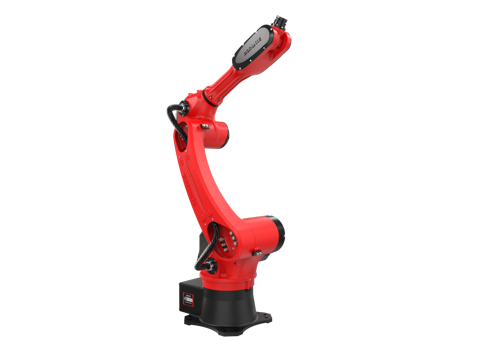
For a two-station cosmetic spray cell, the robot platform must match payload, reach, and repeatability to the gun package and part envelope. As a reference point, the BORUNTE BRTIRUS1510A is a six-axis robot with a 10 kg payload, 1587 mm arm reach, and ±0.05 mm repeatability — a class of platform that can be considered for spray applications where the gun package and part envelope fit within those limits. Final suitability depends on the gun, the part, and the booth, and should be confirmed during integration engineering.
YGT experience: what we look at first in a two-station spray cell
YGT Robot (Guangdong Yigaite Intelligent Technology Co., Ltd.) works as a system integrator and application provider for industrial robot cells, including spray painting, welding, handling, loading/unloading, and palletizing applications. We are not the robot manufacturer — the robot platform is selected from the BORUNTE range, and our work is to integrate the robot, the turntable, the gun package, the sensing, and the controls into a cell that runs in the customer's booth.
In two-station spray cell projects, we look at four things first:
- The part family and cosmetic acceptance criteria. Film build, gloss, and edge coverage requirements drive the gun and path more than the robot.
- The booth airflow. We treat airflow as a design input, not a site condition to be discovered at commissioning.
- The trigger and part-present logic. This is where most rework happens. It is cheap to define early and expensive to change late.
- The real takt. We build the cycle from load, index, spray, flash-off, and recovery — not from spray time alone.
Our two-station spray painting turntable project work is an example of this integration approach: the turntable, robot, gun, and controls are engineered together rather than assembled from separate quotes.

Communication and controls
For spray cells integrated into a plant network, the robot platform supports native Modbus RTU, Modbus TCP, CAN, and digital IO. For fieldbus systems such as EtherCAT, PROFINET, CC-Link, and DeviceNet, native support is not available, but bridging via a gateway or protocol converter to our Modbus/CAN/IO side is possible. The specific bridge configuration should be confirmed with YGT engineers against the customer's PLC and network architecture.
FAQ
Q1. How do I decide between a fixed turntable and a continuously rotating one? A fixed turntable indexes to position and holds during spray. A continuously rotating turntable can improve coverage on cylindrical or complex parts, but it changes how the part is exposed to booth airflow and how the gun path is programmed. The choice usually follows from part geometry and cosmetic acceptance criteria.
Q2. Where should the gun trigger signal come from? For most two-station spray cells, the trigger comes from the robot controller, driven by the path program. A separate PLC or gun controller is used when the customer wants centralized recipe management or when the gun package requires independent flow control. The decision affects programming, troubleshooting, and spare parts.
Q3. What part-present sensing is actually needed? At minimum, presence detection to prevent spraying an empty station. For high-mix cosmetic parts, identity detection (which part family) and orientation detection (is it seated correctly) are usually worth adding — a mis-seated cosmetic part is a scrap part, and a wrong-recipe spray is a rework part.
Q4. How much does booth airflow affect the spray result? Significantly. Airflow direction and velocity affect overspray travel, dry spray, and film build. A cell that sprays well in still air may not spray well in a real booth. Airflow should be treated as a design input during sourcing, not discovered at commissioning.
Q5. How do I match cycle time for high-mix cosmetic parts? Build the cycle from all components: load/unload, index, gun approach, spray, flash-off, booth recovery, and color change/purge. The effective takt is set by the slowest component, not by spray time alone. For high-mix work, color change and purge frequency often become the limiting factor.
Q6. Can the robot platform support EtherCAT or PROFINET? Native support is not available for EtherCAT, PROFINET, CC-Link, or DeviceNet. Bridging via a gateway or protocol converter to Modbus/CAN/IO is possible, and the specific configuration should be confirmed with YGT engineers based on the customer's PLC and network.
Q7. What information should I prepare before requesting a spray cell quote? Part family and geometry, cosmetic acceptance criteria (film build, gloss, edge coverage), substrate and coating system, target takt, booth dimensions and airflow, and the plant control/network standard. This set lets the integration engineering start on the right assumptions.
Related products
- BRTIRUS1510A six-axis robot — 10 kg payload, 1587 mm reach, ±0.05 mm repeatability, used as a platform for spray and other applications.
Next step
If you are sourcing a two-station spray painting cell for high-mix cosmetic parts, the useful next step is not a price — it is a short technical review of your part family, cosmetic criteria, booth airflow, and takt. YGT engineers can review these inputs and confirm which parts of the cell can be standardized and which need application-specific engineering.