Specifying a BRTIRUS1510A Six-Axis Robot Cell for Multi-Station Rotary Turntable Spray Painting

By the YGT Engineering Team · Guangdong Yigaite Intelligent Technology Co., Ltd. (YGT Robot)
The problem: a robot that paints well is not yet a paint cell that works
Most robotic painting projects do not fail because the robot is too slow or too small. They fail at the interfaces — the places where the robot meets the turntable, the booth, the conveyor and the production schedule.
A multi-station rotary turntable cell is a good example. The turntable indexes parts into and out of the spray zone; the robot has a fixed window of time to cover each part before the table moves again. If the gun-to-part distance drifts, if the index is not repeatable, if the booth airflow pulls the spray pattern sideways, or if the cycle does not match the line, the cell will produce parts — just not the same part twice.
This guide is written for the engineers and sourcing managers who have to sign off on that cell. It walks through the four parameters that decide whether a rotary turntable paint cell is stable in production, and how they interact.
Why automate multi-station spray painting at all
Automating a paint line is not primarily about replacing people. It is about making the coating result repeatable — the same film thickness, the same edge coverage, the same finish, shift after shift.
- Consistent quality. A robot repeats the same path and the same gun-to-part distance on every part and every cycle, which is the precondition for stable film thickness and edge coverage.
- Repeatable production. Once the recipe is validated, it can be recalled exactly — including after a changeover or a maintenance stop.
- Long-term cost control. Paint consumption, rework and touch-up labour are the recurring costs in a paint shop; stable coverage is what keeps them predictable.
- Flexibility. A rotary turntable with multiple stations lets one cell carry several part families, with the robot program selected per station.
In a multi-station layout, the value comes from the combination of robot, turntable and booth — which is why the specification has to be done as a cell, not as a robot purchase.
Solution logic: how a rotary turntable paint cell is put together
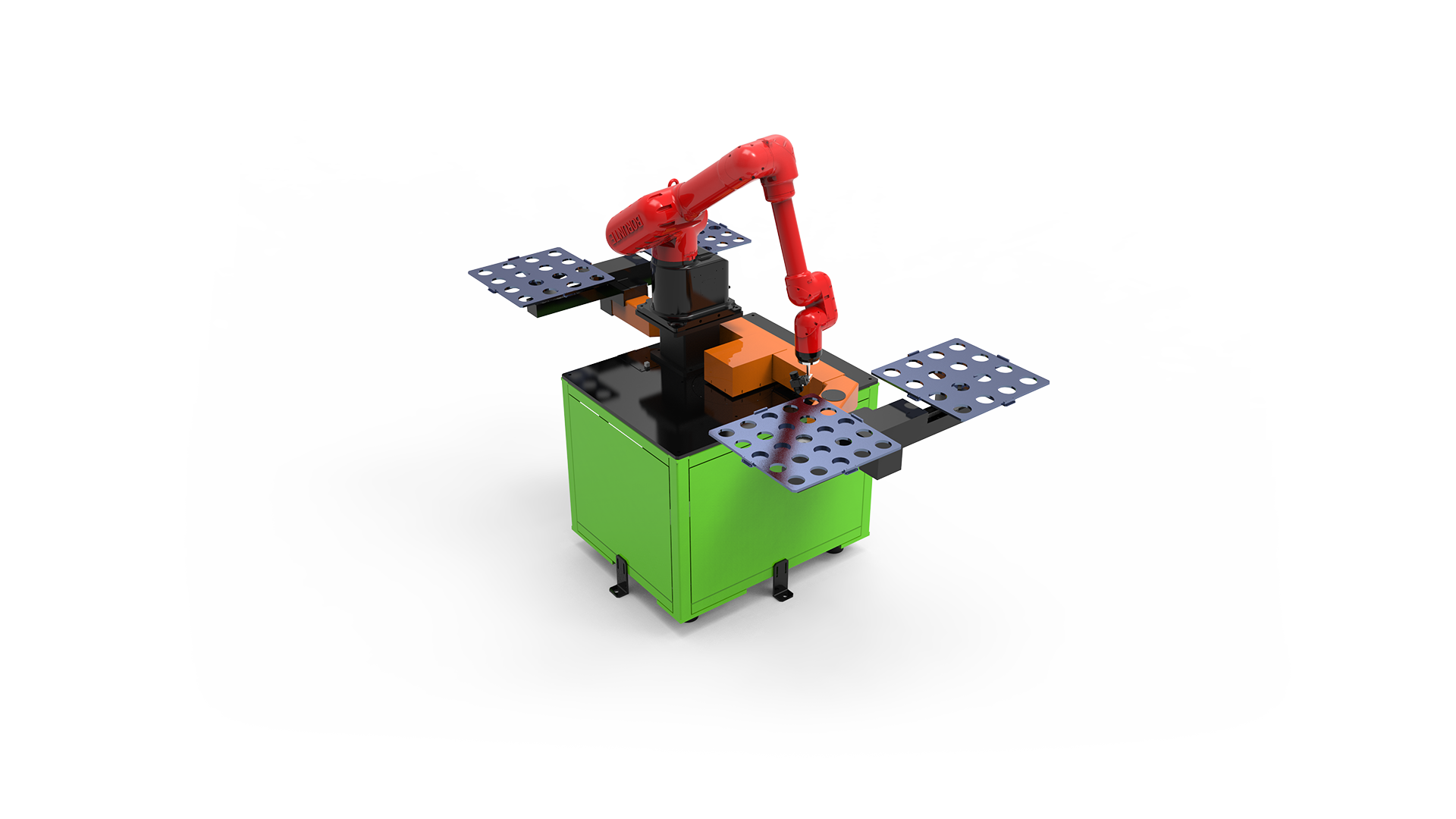
A four-station rotary turntable cell typically has parts loaded at one station, pre-treated or flashed at a second, sprayed at the third, and unloaded at the fourth. The robot is mounted so that it can reach the spray station through the full part envelope.
YGT Robot's role in this kind of project is integration and application engineering: selecting the robot platform, designing the reach and mounting arrangement, defining the spray recipe and the turntable indexing sequence, coordinating the gun and fluid supply, and commissioning the cell against the booth and the line.
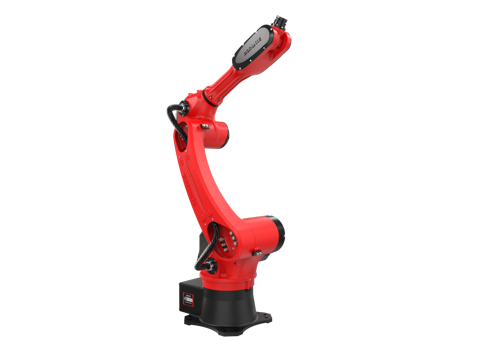
For the spray station itself, the robot platform used in YGT's four-station rotary turntable spray painting project is the BRTIRUS1510A, a six-axis robot supplied by BORUNTE. Its published catalogue figures are the starting point for the reach and payload check:
| BRTIRUS1510A — key catalogue data | Value |
|---|---|
| Robot type | Six-axis industrial robot |
| Payload | 10 kg |
| Arm reach | 1587 mm |
| Repeatability | ±0.05 mm |
| Robot weight | 152 kg |
| Power capacity | 5.06 kVA |
| CE conformity | Yes (2006/42/EC machinery, 2014/35/EU low voltage) |
| Explosion-proof variant | Not applicable to this model |
Source: BORUNTE selection catalogue. YGT Robot integrates this platform into spray painting cells; the robot itself is manufactured by BORUNTE.
One point worth flagging early for paint applications: the BRTIRUS1510A is not an explosion-proof model. Booth classification, solvent handling and the resulting equipment requirements must be settled with the booth supplier and the site's safety assessment before the robot is fixed — this is a cell-level decision, not a robot-level one.
Key selection factors for a rotary turntable paint cell
1. Gun-to-part distance
Gun-to-part distance (also called stand-off) is the single parameter most often treated as a constant when it is in fact a variable. It determines spray pattern width, transfer efficiency and film thickness. If the distance changes between stations, or drifts over a long production run, the coating result changes with it — even though the robot program has not changed.
For specification, the practical questions are:
- What is the nominal gun-to-part distance for the gun type and pattern width you need?
- What is the tolerance around that nominal distance across the full part envelope — including the tallest and widest parts on the turntable?
- Does the robot's reach comfortably cover the spray station at that distance, with margin for the gun and any wrist offset?
The BRTIRUS1510A's 1587 mm arm reach gives a working envelope, but the usable figure is smaller once the gun, mounting bracket and the required stand-off are accounted for. Reach should be checked against the worst-case part at the spray station, not the nominal part.
2. Turntable indexing
The turntable is the cell's clock. Its index time and positional repeatability set the time budget the robot has to work with, and any inconsistency in the index shows up as a coating defect.
Specify:
- Index time per station move, and whether it is a fixed dwell or a variable one.
- Positional repeatability of the table at the spray station — the part must arrive in the same place every cycle, or the robot path will be correct but the part will not be.
- Station-to-station alignment, since a part sprayed at station 3 must be positioned the same way it was taught.
- Handshake logic between the turntable controller and the robot controller: when the table is locked, when the robot is permitted to spray, and what happens on a fault or an emergency stop.
A common specification gap is treating the turntable as a mechanical device rather than as part of the control system. The interlocks between table, robot and booth are where many cells lose time or produce scrap.
3. Booth airflow
Booth airflow is the parameter most often left to the booth supplier and then discovered to matter during commissioning. Downdraft airflow removes overspray and carries solvent away, but it also exerts a force on the spray pattern. Uneven or excessive airflow at the spray station can deflect the pattern, thin the film on one side of the part, or push overspray onto a freshly coated surface.
For the cell specification, confirm:
- The airflow velocity and direction at the spray station, measured at the working height of the part.
- Whether the airflow is uniform across the spray zone, or varies with the part's position on the turntable.
- The interaction between airflow and gun-to-part distance — a pattern that is stable at one stand-off may not be stable at another.
- Booth filtration and balance over time: a booth that is balanced when clean may not be balanced when the filters are loaded.
This is the parameter that most clearly requires the robot integrator and the booth supplier to work from the same numbers. YGT's approach in paint cell projects is to treat the booth conditions as part of the spray recipe validation, not as an external given.
4. Cycle time matching to the paint line
The cell's cycle time is set by the slowest of: turntable index time, robot spray time per part, and load/unload time at the other stations. Matching the cell to the line means making sure the cell's effective cycle — including index, spray, and any dwell — is at or below the line's takt.
Work through:
- Takt time of the paint line, and the required parts per hour at the cell.
- Spray time per part, which depends on the number of passes, the pattern width, the part geometry and the required film thickness.
- Index and dwell time of the turntable, including any settling time before spraying is permitted.
- Load/unload time, and whether it overlaps with spraying at other stations.
- Changeover and recipe recall time when switching part families.
A cell that is specified at the nominal cycle but has no margin for recipe changes, gun cleaning or a slower part will run behind the line in practice. The specification should state the required takt and the expected worst-case part.
Comparison: what to fix at specification vs. what can be tuned at commissioning
| Parameter | Fix at specification | Tune at commissioning |
|---|---|---|
| Gun-to-part distance | Nominal distance and tolerance across the part envelope | Final stand-off per recipe, within the specified tolerance |
| Turntable indexing | Index time, repeatability, handshake logic with robot | Dwell and settling time within the specified limits |
| Booth airflow | Velocity, direction and uniformity at the spray station | Balance and filter condition at start-up |
| Cycle time | Takt, worst-case part, changeover allowance | Pass count and path optimisation within the recipe |
| Robot reach and payload | Reach against worst-case part, gun and bracket weight | Mounting position and wrist configuration |
Treating the left-hand column as fixed and the right-hand column as adjustable keeps the project scope clear: the cell is specified against numbers, and commissioning confirms them rather than discovering them.
YGT Robot's experience in rotary turntable paint cells
YGT Robot (Guangdong Yigaite Intelligent Technology Co., Ltd.) works on the integration and application side of robotic paint cells — the part of the project where the robot, the turntable, the gun and the booth have to agree.
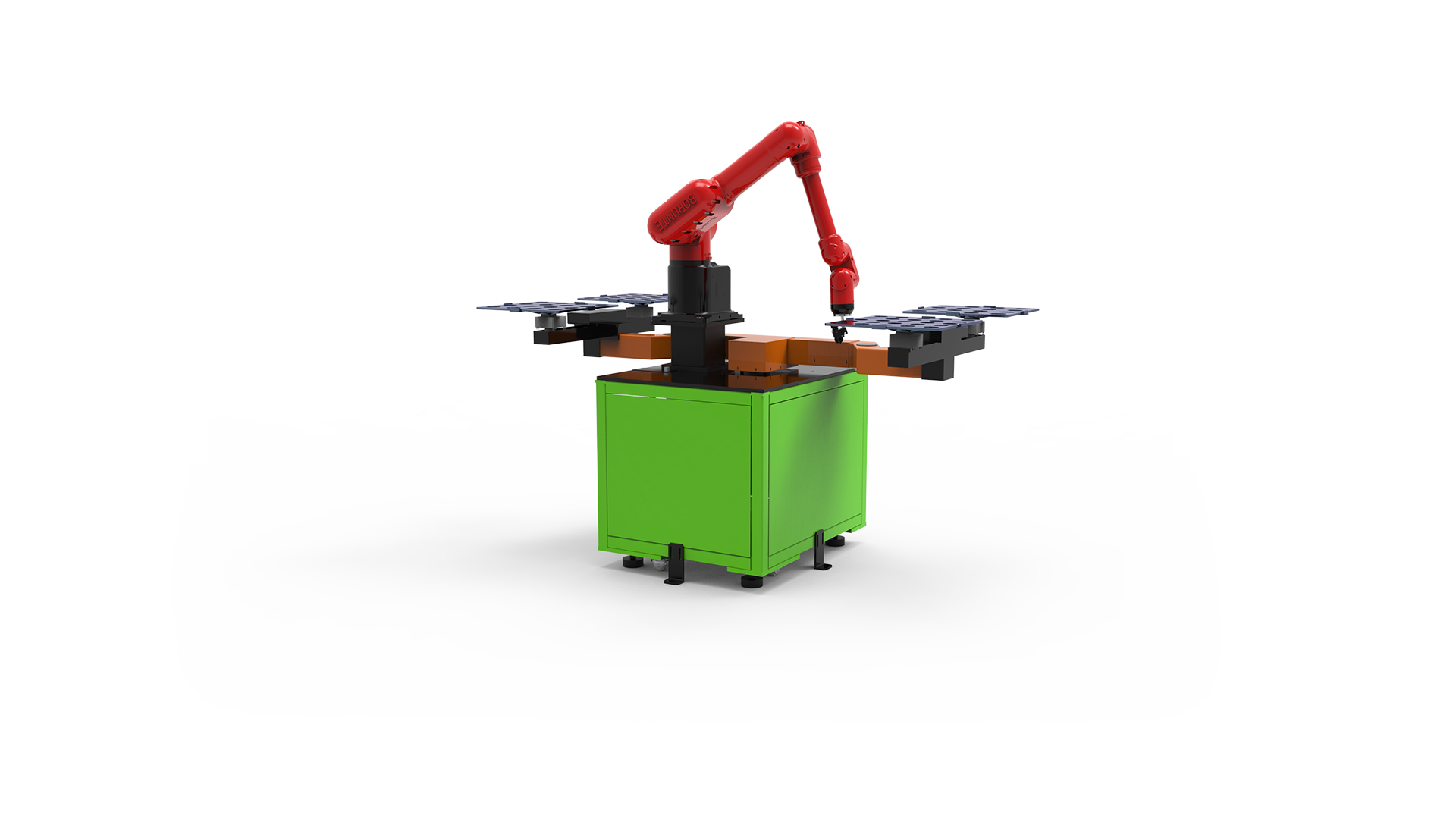
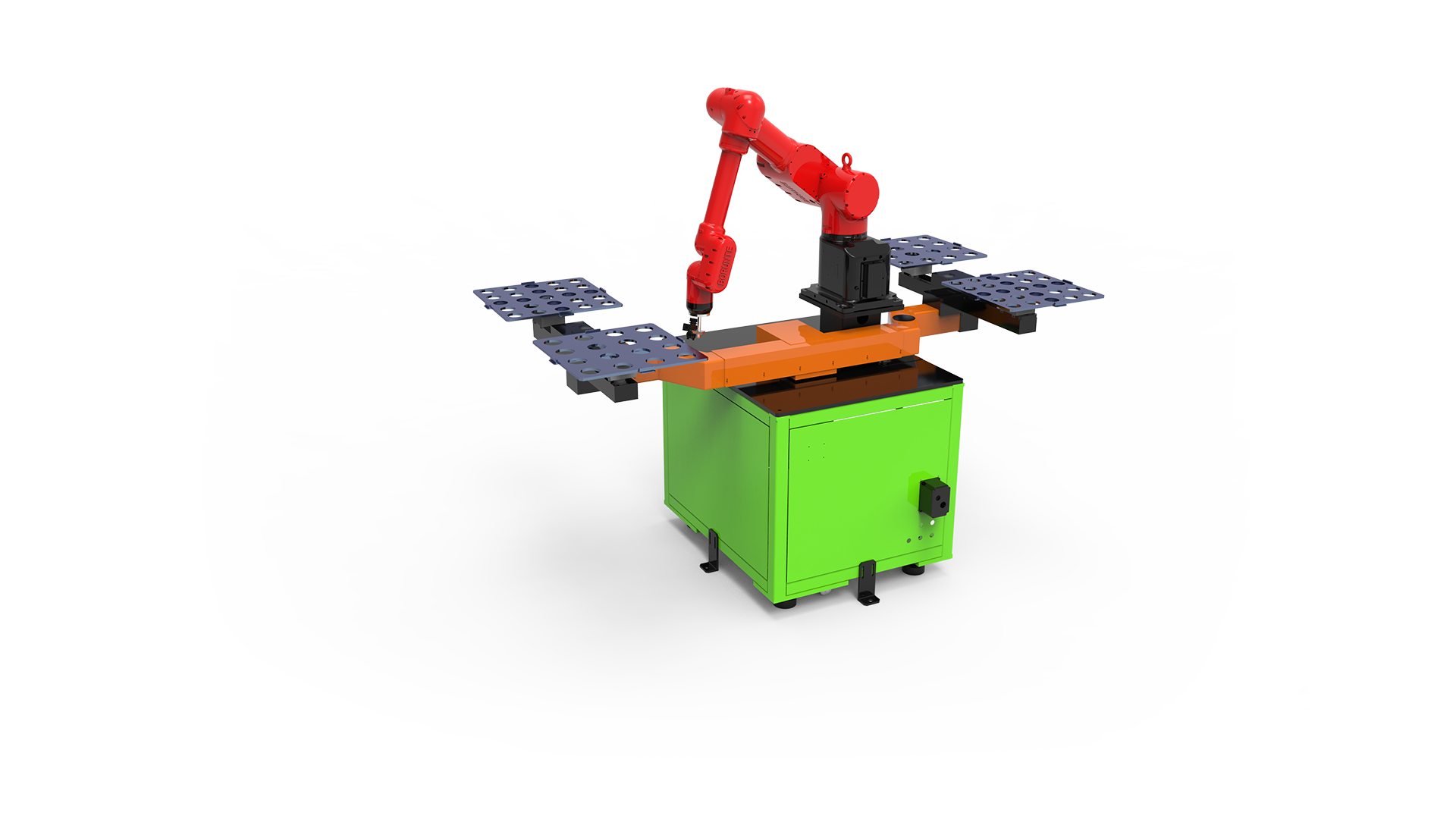
In the four-station rotary turntable spray painting project, the BRTIRUS1510A is used as the spray robot, with the turntable carrying parts through load, preparation, spray and unload stations. The engineering work in that kind of layout sits in the interfaces: the reach check against the tallest part at the spray station, the handshake between the turntable and the robot controller, the spray recipe validation against the booth's airflow, and the cycle calculation against the line's takt.
YGT's declared application scope covers spraying, welding, handling, loading/unloading and palletizing. Applications outside that scope — including degreasing, grinding, polishing, adhesive dispensing, vision sorting, laser cutting and assembly — are not confirmed and should be discussed with YGT engineers before being written into a specification.
FAQ
Q: Can the BRTIRUS1510A reach all four stations of a rotary turntable cell?
A: The robot is normally mounted to spray at one station, with the turntable indexing parts into and out of that station. Its 1587 mm arm reach is the catalogue figure; the usable reach at the spray station depends on the gun, bracket and required gun-to-part distance. Reach should be checked against the tallest and widest part at the spray station, not the nominal part.
Q: What payload does the BRTIRUS1510A offer, and is it enough for a spray gun?
A: The catalogue payload is 10 kg. A spray gun and its mounting bracket are usually well within that, but the payload figure should be checked against the actual gun, fluid lines and any wrist-mounted equipment, and against the robot's payload at the required reach.
Q: Is the BRTIRUS1510A suitable for a solvent-based paint booth?
A: The BRTIRUS1510A is not an explosion-proof model. Booth classification and the equipment requirements that follow from it must be settled with the booth supplier and the site's safety assessment. Where an explosion-proof robot is required, that is a separate selection decision.
Q: How do I decide the gun-to-part distance for a multi-station cell?
A: Start from the gun type and the pattern width you need, which give a nominal stand-off. Then define the tolerance across the full part envelope, and check that the robot can hold that distance at the worst-case part. The distance should be validated against the booth airflow at commissioning, because the two interact.
Q: How does turntable indexing affect the spray program?
A: The turntable sets the time the robot has at the spray station and the position the part arrives in. Index time and positional repeatability should be specified, and the handshake between the turntable controller and the robot controller — when the table is locked and when spraying is permitted — should be defined as part of the cell control design.
Q: How is cycle time matched to the paint line?
A: The cell's effective cycle is the sum of index time, spray time and any dwell, with load/unload overlapping where the layout allows. It should be calculated against the line's takt and the worst-case part, with allowance for changeover and recipe recall.
Q: Does YGT Robot supply the turntable and booth as well as the robot?
A: YGT Robot's role is integration and application engineering for the paint cell — robot selection, reach and mounting design, spray recipe, turntable indexing sequence, and commissioning against the booth and line. The scope of turntable and booth supply is agreed per project; it should be confirmed in the project specification.
Q: What information should I prepare before requesting a paint cell quotation?
A: Part geometry and the full part family, required film thickness and finish, line takt, booth type and airflow data, turntable layout and index time, and the gun type. With those, the reach, payload, cycle and interface checks can be done against numbers rather than assumptions.
Related product
- BRTIRUS1510A six-axis industrial robot — the robot platform used in YGT's four-station rotary turntable spray painting project.
Next step
If you are specifying a rotary turntable paint cell, the useful first conversation is about your part envelope, your line takt and your booth conditions — not about the robot alone. Send those three and YGT engineers can check reach, payload, cycle and the turntable/robot interface against your actual production, and tell you which points need confirmation before the specification is fixed.